

AI Requirement Validation & Technology Advisory

AI Can Generate the Requirement. We Validate the Reality.

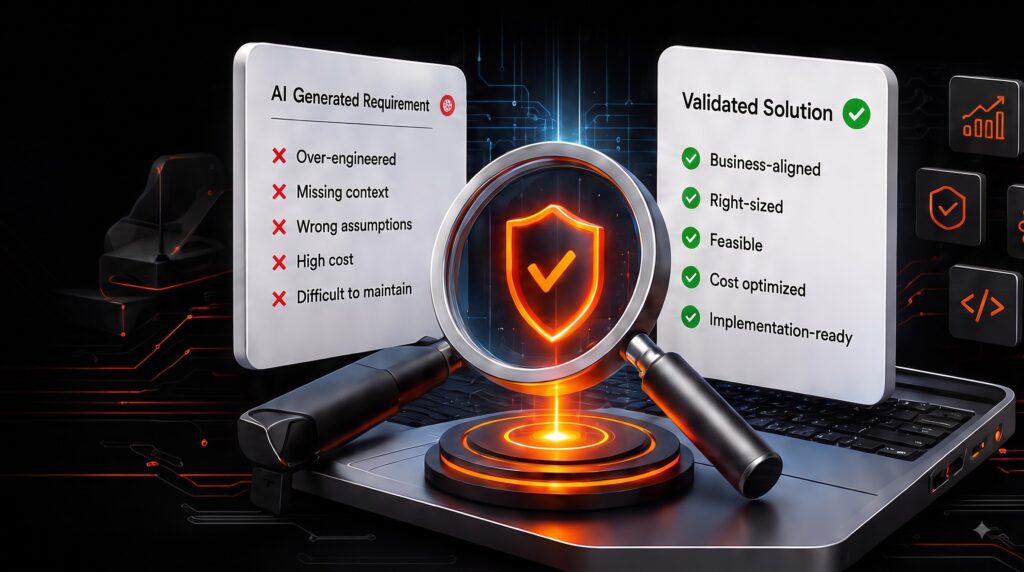
AI tools can produce impressive technology specifications in seconds. But a technically sophisticated document does not necessarily mean the right solution has been identified.

Our AI Requirement Validation & Technology Advisory service independently evaluates AI-generated, consultant-generated or internally prepared technology requirements and converts them into business-aligned, technically validated and implementation-ready solutions.

Bring us what AI told you to build. We’ll help you determine what you actually need to build.

The Problem

Your Requirement May Look Complete. That Doesn’t Mean It Is.

Today, anyone can use ChatGPT, Gemini or another AI platform to generate:

  • ChatGPT Image Aug 17, 2026, 02_16_08 PM
    Product requirements
  • ChatGPT Image Aug 17, 2026, 02_19_43 PM
    Software specifications
  • ChatGPT Image Aug 17, 2026, 02_16_18 PM
    Technical architectures
  • ChatGPT Image Aug 17, 2026, 02_20_48 PM
    Technology stacks
  • ChatGPT Image Aug 17, 2026, 02_20_48 PM
    AI/ML recommendations
  • ChatGPT Image Aug 17, 2026, 02_20_48 PM
    Database designs
  • ChatGPT Image Aug 17, 2026, 02_28_27 PM
    API specifications
  • ChatGPT Image Aug 17, 2026, 02_23_12 PM
    Cloud architectures
  • ChatGPT Image Aug 17, 2026, 02_23_12 PM
    Development roadmaps
  • ChatGPT Image Aug 17, 2026, 02_23_12 PM
    Project estimates

The problem is that technical language can create a false sense of certainty.

An AI-generated specification may be:

  • Technically plausible but commercially impractical
  • Over-engineered for the actual requirement
  • Missing critical business requirements
  • Based on incorrect assumptions
  • Unsuitable for your users or operating environment
  • Incompatible with existing systems
  • More expensive than necessary
  • Difficult to scale or maintain
  • Inappropriate from a security or compliance perspective
  • Solving the wrong problem exceptionally well

The question isn’t whether AI’s answer sounds intelligent.

The question is whether it is the right solution for your business.

The New Reality

You Don’t Need to Stop Using AI. You Need Someone to Validate It.

We don’t believe clients should stop using AI to explore their technology requirements.

Quite the opposite.

Use AI

Explore

Ask questions

Generate ideas

Challenge assumptions

Then bring the output to us.

We take your AI-assisted requirements and apply business context, technology expertise, architecture experience, implementation knowledge and commercial judgement to determine what should actually be built.

AI assists the thinking. We validate the solution.

What We Validate

From AI-Generated Ideas to Implementation-Ready Requirements

Our assessment examines your proposed solution across multiple dimensions

01 — Business Alignment

Does the proposed technology actually solve the business problem?

We examine:

  • Business objectives
  • User needs
  • Business processes
  • Expected outcomes
  • Success criteria
  • Operational requirements
  • ROI assumptions

02 — Requirement Completeness

What is missing from the requirement?

We identify:

  • Technical feasibility
  • Integration requirements
  • API availability
  • Data availability
  • Platform limitations
  • Infrastructure requirements
  • Third-party dependencies
  • Technology maturity

03 — Technical Feasibility

Can the proposed solution actually be built as described?

We evaluate:

  • Technical feasibility
  • Integration requirements
  • API availability
  • Data availability
  • Platform limitations
  • Infrastructure requirements
  • Third-party dependencies
  • Technology maturity

04 — Architecture Validation

Does the proposed architecture make sense?

We assess:

  • Application architecture
  • Cloud architecture
  • Data architecture
  • API architecture
  • Integration architecture
  • AI architecture
  • Infrastructure design
  • Scalability
  • Availability
  • Maintainability

05 — Technology Selection

Does the requirement actually need the technologies proposed?

We challenge assumptions around:

  • Programming languages
  • Frameworks
  • Databases
  • Cloud platforms
  • AI models
  • Vector databases
  • RAG architectures
  • Microservices
  • Serverless
  • Containers
  • APIs
  • SaaS platforms
  • Open-source components

The objective isn’t to use more technology. It’s to use the right technology.

06 — AI & Automation Validation

AI is increasingly included in requirements simply because it is available.

We determine:

  • Where AI genuinely adds value
  • Where conventional software is better
  • Where automation is sufficient
  • Whether an LLM is actually required
  • Whether RAG is appropriate
  • Whether fine-tuning is justified
  • What data AI requires
  • What human oversight is necessary
  • Expected accuracy and limitations
  • AI operating costs

AI is increasingly included in requirements simply because it is available.

We determine:

07 — Security & Privacy

We identify potential security and data risks including:

  • Authentication
  • Authorization
  • Data protection
  • API security
  • Access controls
  • Data storage
  • Third-party data exposure
  • AI model data handling
  • Sensitive information
  • Infrastructure security
  • Security dependencies

08 — Scalability & Performance

A solution designed for 100 users may not work for 100,000.

We examine:

  • Expected user volumes
  • Transaction volumes
  • Data growth
  • API traffic
  • AI inference requirements
  • Infrastructure scaling
  • Performance bottlenecks
  • Availability requirements
  • Disaster recovery considerations

09 — Commercial Viability

Technology decisions have financial consequences.

We assess:

  • Development complexity
  • Infrastructure costs
  • SaaS costs
  • API costs
  • AI model costs
  • Licensing
  • Maintenance
  • Support
  • Scaling costs
  • Vendor dependency
  • Total Cost of Ownership

A solution designed for 100 users may not work for 100,000.

We examine:

10 — Implementation Reality

A document can look perfect on paper and still be difficult to implement.

We assess:

  • Development effort
  • Skills required
  • Dependencies
  • Integration complexity
  • Project sequencing
  • Development risks
  • Testing requirements
  • Deployment requirements
  • Operational requirements

The New Reality

You Don’t Need to Stop Using AI. You Need Someone to Validate It.

We don’t believe clients should stop using AI to explore their technology requirements.

Quite the opposite

Use AI

Explore

Ask questions

Generate ideas

Challenge assumptions

Then bring the output to us.

We take your AI-assisted requirements and apply business context, technology expertise, architecture experience, implementation knowledge and commercial judgement to determine what should actually be built.

AI assists the thinking. We validate the solution.

Business Requirement

What are you trying to achieve?
Example: "Customers should be able to upload documents and receive an automated analysis."

Proposed Solution

What do you or your AI tool believe you need? Example: "We need RAG, a vector database, GPT, microservices and Kubernetes."

Validated Solution

What do you actually need to achieve the objective? Our team determines this through technical and business validation. This distinction prevents technology from becoming the requirement

We Separate What You Want From What You Think You Need

One of the most important parts of our process is separating three things that are often mixed together

The AI Requirement Validation Framework

What You Can Bring Us

Your Starting Point Doesn't Need to Be Perfect.

You can come to us with:

An AI-generated document

“ChatGPT designed the entire application.”

A business idea

“I have an idea but don’t know what technology I need.”

An RFP

“Our procurement team has received several proposals.”

A technical specification

“Our consultant has already designed the architecture.”

A development proposal

“A vendor has quoted us ₹X crore. Is it reasonable?”

A product concept

“We want to build something similar to this platform.”

An existing application

“We want to modernise or rebuild our current system.”

A collection of AI outputs

“We asked ChatGPT, Gemini and Claude and received different answers.”
What We Deliver

From Requirement to Decision-Ready Technology Plan

Depending on the engagement, our deliverables can include
  • 5
    Business & Requirement Assessment • Business objective assessment • Requirement decomposition • Requirement gaps • Ambiguity identification • Assumption register • Business process assessment
  • 6
    Technical Assessment • Technical feasibility assessment • Architecture review • Technology assessment • Integration assessment • AI architecture assessment • Data architecture assessment • Security considerations • Scalability assessment
  • 7
    Commercial Assessment • Development complexity • Infrastructure considerations • Third-party costs • AI/API costs • Licensing considerations • Total Cost of Ownership • Build vs buy assessment
  • 8
    Implementation Planning • Recommended architecture • Technology stack • Development roadmap • Implementation phases • Dependencies • Risks • Resource requirements • Indicative effort • Implementation priorities

The Final Output

You Don’t Leave With Another AI-Generated Document.

You leave with a validated technology decision.

Depending on the engagement, your final advisory package may contain

Executive Assessment

What you are trying to achieve and whether the proposed approach supports it.

Requirement Validation Report

What is correct, incomplete, ambiguous or unnecessary

Technical Architecture Recommendation

What should be built and why.

Technology Stack Recommendation

Which technologies should be considered and why.

AI Assessment

Where AI should—and should not—be used.

Risk & Dependency Register

What could affect delivery, cost or performance.

Implementation Roadmap

What should be built first, next and later.

Commercial Assessment

Key cost drivers and potential optimisation opportunities.

Development Scope

A clearer basis for RFPs, proposals, SOWs and vendor discussions.

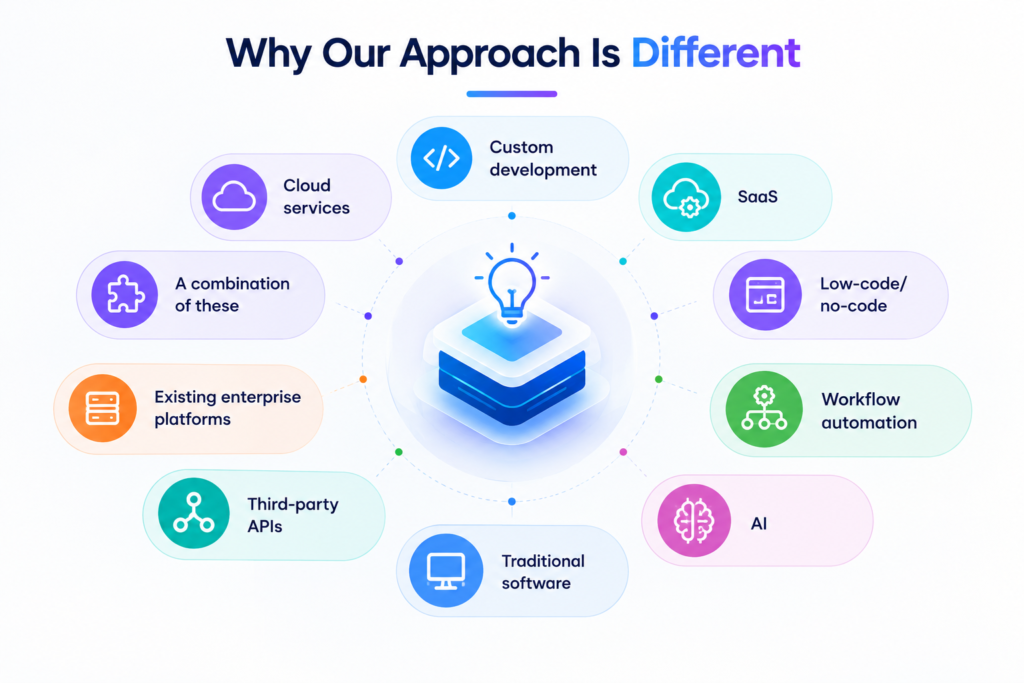
Why Our Approach Is Different

We Don’t Start With Technology. We Start With the Outcome.

Many technology engagements begin with:

“What technology should we use?”

We start with:

“What are you trying to accomplish?”

That difference matters.

Because the same business objective can potentially be achieved through:

Custom development

SaaS

Low-code/no-code

Workflow automation

AI

Traditional software

Cloud services

Third-party APIs

Existing enterprise platforms

A combination of these

Our job isn’t to justify technology.

Our job is to determine the most appropriate technology

Methodology

  • ChatGPT Image Aug 17, 2026, 02_16_08 PM
    Discover · Applications · Servers · Databases · Networks · Dependencies · Users · Business criticality · Existing operations
  • ChatGPT Image Aug 17, 2026, 02_19_43 PM
    Assess · Cloud readiness · Technical complexity · Dependencies · Security · Performance · Availability · Modernization opportunities
  • ChatGPT Image Aug 17, 2026, 02_16_18 PM
    Strategize Each workload is evaluated against the appropriate migration approach. The objective is to avoid blindly applying a lift-and-shift methodology to every application.
  • ChatGPT Image Aug 17, 2026, 02_20_48 PM
    Mobilize · Accounts · IAM · Networking · Security controls · Logging · Monitoring · Backup · Governance · Operating processes
  • ChatGPT Image Aug 17, 2026, 02_20_48 PM
    Migrate Migration waves follow: Plan → Build → Test → Migrate → Validate → Stabilize
  • ChatGPT Image Aug 17, 2026, 02_28_27 PM
    Modernize Where appropriate, applications can be replatformed, refactored, containerized, automated or redesigned using cloud-native architectures.
  • ChatGPT Image Aug 17, 2026, 02_23_12 PM
    Optimize · Cost · Performance · Security · Reliability · Scalability · Operations

AWS itself describes migration and modernization as complementary stages of cloud transformation.

AI vs Human Expertise

AI Is Powerful. But It Doesn’t Own the Outcome

AI can:

  • Generate possibilities
  • Explain technologies
  • Produce architectures
  • Compare alternatives
  • Generate code
  • Create documentation

But AI doesn't inherently know:

  • Your organisational realities
  • Your internal processes
  • Your customers
  • Your budget constraints
  • Your existing infrastructure
  • Your people
  • Your operational limitations
  • Your vendor relationships
  • Your regulatory environment
  • Your long-term business strategy

And most importantly:

AI doesn’t carry responsibility for the implementation decision.

That’s where experienced technology advisory matters

Companies Modernising Legacy Systems

You need to determine whether to rebuild, modernise, replace or integrate existing technology.

Procurement & CXO Teams

You need an independent technical assessment before selecting a technology vendor.

Companies Using AI to Define Projects

Your team has generated requirements using ChatGPT, Gemini, Claude or another AI platform and wants professional validation.

Companies Comparing Vendors

Different vendors are proposing different architectures, technologies and costs.

Founders & Entrepreneurs

You have an idea, but don't want to spend millions building the wrong product

Business Leaders

Your organisation has identified a technology initiative but you need independent validation.

Non-Technical Executives

You have received a highly technical proposal and need to understand whether it actually makes sense.

Built for Businesses That Don’t Want to Make Expensive Technology Decisions Blindly.

This service is particularly useful for:

Who Is This For?

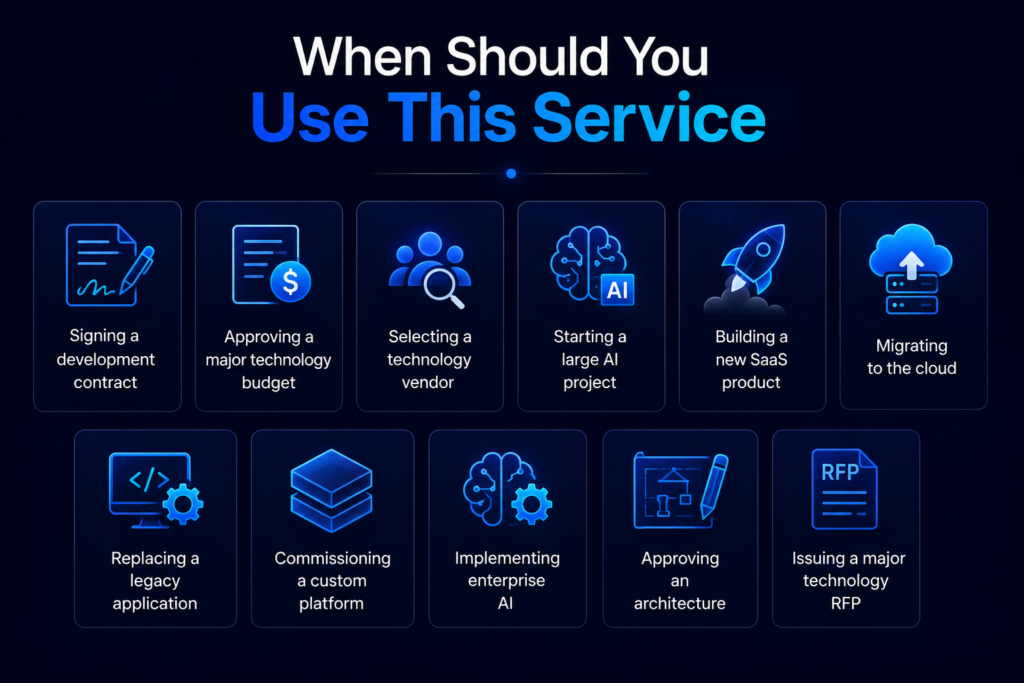
When Should You Use This Service?

Before You Spend Money Building the Wrong Thing.

Consider validation before:

  • Signing a development contract
  • Approving a major technology budget
  • Selecting a technology vendor
  • Starting a large AI project
  • Building a new SaaS product
  • Migrating to the cloud
  • Replacing a legacy application
  • Commissioning a custom platform
  • Implementing enterprise AI
  • Approving an architecture
  • Issuing a major technology RFP
The earlier we validate the requirement, the cheaper it is to correct mistakes

Example

What a Client Might Bring Us

“ChatGPT says we should build a multi-tenant SaaS platform using React, Node.js, Kubernetes, PostgreSQL, Redis, Kafka, a vector database, RAG and multiple LLMs.”

Our first response isn’t:

“That’s wrong.”

It is:

“Let’s understand what you’re trying to achieve.”

We then ask:

  • How many customers?
  • What are they doing?
  • What data is involved?
  • What workflows are required?
  • What integrations exist?
  • What are the expected volumes?
  • What are the response-time requirements?
  • What AI functionality is actually required?
  • What is the commercial model?
  • What is the expected scale?
  • What are the security and compliance requirements?

Only then do we determine whether the proposed architecture is appropriate.

Sometimes the AI-generated architecture will be right.

Sometimes it will be unnecessarily complex.

Sometimes a completely different solution will be better.

That’s precisely why validation exists

Our Engagement Model

Submit

Share your requirement, proposal, AI-generated document, architecture or business idea.

Discover

We understand the business objective, users, processes, constraints and expectations.

Challenge

We identify assumptions, gaps, contradictions, unnecessary complexity and potential risks.

Validate

We independently assess the proposed technical approach.

Recommend

We provide the architecture, technology and implementation approach we believe best fits the requirement.

Decide

You receive the information required to make an informed technology decision.

Build

If you choose to proceed with implementation, our validated requirements can become the foundation for development.

Independent Advisory

You Don’t Have to Hire Us to Build It.

This is an important distinction.

Our advisory can be independent of implementation.

You can use our assessment to:

  • Select another development partner
  • Compare vendor proposals
  • Negotiate with an existing vendor
  • Prepare an RFP
  • Validate an internal technology proposal
  • Build internally
  • Decide not to build at all

Our first responsibility is to the quality of the technology decision—not to creating development work for ourselves.

If implementation is appropriate, we can support it.

If it isn’t, we’ll tell you that too.

The Business Value

The Cost of Validation Is Small Compared With the Cost of Building the Wrong Solution.

A flawed assumption discovered during discovery may cost hours to correct

The same assumption discovered after development can cost:

  • Weeks of rework
  • Additional development costs
  • Architecture changes
  • Vendor disputes
  • Delayed launches
  • Security remediation
  • Infrastructure migration
  • Customer dissatisfaction
  • Lost revenue

We move expensive mistakes from development into discovery—where they are cheaper to fix.

FAQ

What is an AWS Partner?
AWS Partners are organizations that provide technology products, consulting, professional services, managed services and other capabilities that help customers adopt and use AWS.


Is Ouriken an AWS Partner?
Yes. Ouriken Consulting operates an AWS Partner practice and has a solution available through AWS Marketplace.


Is Ouriken listed on AWS Marketplace?

Yes. Ouriken has an AWS Marketplace seller profile and a listed solution.

Can Ouriken help us migrate to AWS?
Yes. Ouriken provides AWS migration consulting covering assessment, strategy, architecture, mobilization, migration, validation and optimization.


Can Ouriken modernize our existing applications?
Yes. Depending on the workload, modernization may include replatforming, refactoring, re-architecting, containerization, serverless, microservices, API modernization or database modernization.


Can you assess our existing AWS environment?
Yes. Ouriken can assess AWS architecture, security, reliability, performance, operations and cost optimization opportunities.


Can you help reduce AWS costs?
Yes. We can evaluate utilization, resources and architecture to identify AWS cost optimization opportunities.


Does Ouriken provide ongoing AWS support?
Yes. Ouriken can provide AWS support and managed cloud services based on the required scope and operating model.


Can we purchase an Ouriken solution through AWS Marketplace?
Ouriken has a solution listed on AWS Marketplace. Customers can access the applicable listing and engage through the AWS Marketplace process.


Do you only work with companies already using AWS?
No. We work with organizations evaluating AWS, planning migration, building new applications, modernizing existing systems or optimizing existing AWS environments.
 

Have an AI-Generated Technology Requirement?
Don't throw it away. Don't blindly implement it either.

We'll help you understand:

  • What is correct.
  • What is missing.
  • What is unnecessary.
  • What is risky.
  • What needs to change.
  • And what should actually be built
  • We'll Tell You What It Really Means.